
Tooling switch reduces setup time, improves tool life
Table of Contents
Shrink-fit headaches
Hydromechanical fix
Proven performance
Setup revolution
Fermer Precision (Ilion, NY) got more than it hoped for after setting out to improve throughput on its precision vertical and horizontal machining centers. The company was able to reduce tooling inventory and setup time from hours to seconds and eliminate existing drills and shrink-fit toolholders by switching to a high-precision, hydromechanical clamping toolholder and a dual-grade drill having high toughness and good wear resistance. The switch to Sandvik Coromant Company's Delta C GC1020 drill and the Sandvik CoroGrip toolholder increased tool life up to 200 percent and shortened tooling setup times by 350 percent.
Shrink-fit headaches
The retooling process started when Rick Bunce, engineering manager, decided that tool life on the drilling operation was unacceptable. The powdered-metal core drills were supposed to last 200 parts/drill, but were only averaging 120. Bunce was also concerned about operator safety when it came time to replace dulled drills. Operators were at risk of burning their hands when removing the tooling from the shrink-fit toolholders.
"The shrink-fit toolholders are very difficult to use at times," Bunce explained. "Any time you use tools with steel shanks as opposed to solid carbide, the coefficient of expansion of the toolholder and the tool's steel shank are too close to the same. Because of this, as the toolholder is heated to release the tool, the shank grows at almost the same rate. In most cases, you need to use a mallet and a drive punch to remove the tool.
"After replacement of the drill, the toolholder still could not be used for another 1.5 hours," he continued. "It took that long to cool down enough for handling and then retooling."
The long retooling times required Fermer to keep on hand three times the number of toolholders actually needed for drilling. "We had to stock more tooling to keep the machines running," Bunce said. "While some of the toolholders were being used in the machine, others were cooling following a tool change. Still others were idle near the machining centers waiting to be reinstalled."
Bunce decided it was time to investigate new drills that offered longer tool life. He eventually selected Sandvik's Delta C GC1020 solid carbide drills. The key to their performance is the sintering of two substrate materials together at the drill tip. The grade at the tool center provides toughness, withstands tension and pressure on the drill point. The grade at the tool periphery provides wear resistance at high surface speed. This combination allows high speeds and feeds without sacrificing edge security.
Hydromechanical fix
The chucks can handle high-speed machining applications from finishing to heavy roughing at speeds up to 40,000 rpm. They clamp all types of shanks with or without collets using a unique hydromechanical design that grips the tool firmly and safely in place without slippage. This results in runout the same as shrink-fit or hydraulic chucks and excellent tool balance for high-speed machining, according to Sandvik.
The tools' user-friendly design permits easy length pre-setting and allows clamping of shanks halfway in without affecting performance. Incorrect handling will not damage the chucks, and Sandvik says they require no maintenance.
The chuck guides the tool into the bore with an entering groove. A manual pump applies oil pressure to push a mechanical ring along the outside of a tapered collet. When the oil pressure is released, the locking ring transmits force onto the shank ranging from 2.5 tons for a 12-mm shank up to 10 tons for a 32-mm shank tool. The lock is mechanical, not hydraulic, and is easily released. No heating or cooling and no complex accessories are required.
Proven performance
Feeds and speeds on the machines remain unchanged with the new drill and toolholder. A typical operation is drilling several 0.4313-in.-dia. holes, 1.75-in. deep at 250 sfpm in low-carbon steel workpieces. Programming on the machining center indexes the Delta C drill into place to perform all drilling, then indexes a reamer to finish the holes.
Setup revolution
As a result of faster setup, Fermer no longer needs to inventory more toolholders than necessary to support its drilling operations. "We still have multiple toolholders so we can simply pop in a toolholder when a tool becomes dull and keep the machine up and running. This strategy has added hundreds of hours a year to our useable machine time," he said.
Gone are the gloves and mallet necessary to change drills. Also, a simple tool pot (in Fermer's presetter) is all that is needed to hold the toolholder during tool insertion. During tool setup there are no forces exerted on the clamp or the tool pot, since only shop air is applied to move internal toolholder components.
To release the tool, the operator simply increases oil pressure between the inner body of the toolholder and the sleeve, allowing the sleeve to move down the taper. The design of the CoroGrip toolholder optimizes balance and torque transmission. The absence of a set screw means the tool has good balance for minimal vibration during operation. "This toolholding system allows us to get the best performance from Sandvik's solid carbide drilling tools. The combination has increased overall productivity and the quality of our products," concluded Bunce.
Sandvik Coromant Company, 1702 Nevins Road, Fair Lawn, NJ 07401 USA. Tel: 201-794-5000. Fax: 201-794-5217.
With contribution from Jim Destefani
Fermer machines a variety of precision parts from aluminum, cast iron, powdered metal, carbon steel, and low-carbon steel for automobiles, firearms, medical products, and train brake systems, to name a few. The company relies on two machines—the OKK KVC 600 and Mori Seiki SV-500 VMCs—for drilling, reaming and chamfering operations. Typical drilling requirements for the machines were to drill nine holes in six workpieces mounted in a single fixture.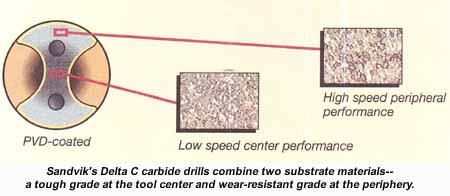
(Return to Table of Contents)
During drill testing, Fermer also tried out CoroGrip high-precision chucks for high-speed machining. Sandvik says the tools' design offers twice the clamping force of shrink-fit chucks and three times that of ordinary hydraulic chucks.
(Return to Table of Contents)
The new tooling combination immediately demonstrated dramatically longer tool life. The average number of parts each drill handled increased from 120 to 300. Depending on the application, Fermer gained an increase from 50 to 200 percent on tool life. The toolholder's low-runout design also was a plus, according to Bunce. "The nearly non-existent runout we have with this toolholder is just great," he said. "The drills and reamers for our applications have to be right on the money, and the CoroGrip is incredibly close." Runout on the chucks is 0.002-mm.
(Return to Table of Contents)
Another improvement for Fermer technicians was the safe, easy, and quick tooling setup with the CoroGrip chucks. The toolholders are fitted with a tool and ready for insertion into the machines in just 15 seconds," said Bunce.
(Return to Table of Contents)
Managing Editor, Tooling Online