
Efficient chip handling key to higher productivity
First, the good news: hybrid machine tools--those that provide multiple machining processes, such as mill/turn centers and machining centers--can have dramatic impact lowering in-process inventory levels, and improving quality through single machine handling.
Now the bad news: these same machines also produce a more diverse selection of chips, from large to small, strings and curled springs, to fine dust-like particles, depending on the work material. And, they can produce a lot of chips in a very short time, overwhelming conventional chip handling and coolant recovery systems in both the variety and amount of chips.
Such was the case at the Pohlman Inc. manufacturing plant in St. Louis, MO. The nearly half-century old company, a Tier II automotive supplier, machines various vehicle components, with particular emphasis on the processing of air bag and supplemental restraint system (SRS) parts.
According to project engineer Mike Keithly, one manufacturing cell, consisting of two Turmatic machining systems processing aluminum SRS canister housings, presented a special chip handling challenge.
"The two machines run 24 hr a day, seven days a week, each processing over 60,000 of the housings per week," Keithly says. "The machines are set up to drill, thread mill, mill, and turn a variety of features on the impact-formed housing blanks, producing everything from fines and small particles to long strings from a facing operation.
"And, they produce a lot of chips—up to 210 ft3 of chips per day, per machine," he continues. "The machines themselves provide excellent performance, day in and day out, but the chip and coolant handling conveyors and wedge wire filters were unable to produce clean coolant, resulting in a loss of productivity we could not accept and still meet the demands for delivery to our customers."
The result was a weekly shut-down of from eight to 12 hr--roughly 5 to 8% of the machines' projected spindle run time each seven-day period--to clean chips and fines from the machines' 800-gal coolant filtering systems. "Any longer than that, and coolant levels would back up and overflow," Keithly notes.
"We also saw that chips were passing through to the 'clean side' of the system, meaning the potential for blockages was greater, resulting in reduced coolant flow which in turn is detrimental to tool life and can affect dimensional and surface finishes, he says. "Plus, these clean-side contaminates, recirculating through the system, can increase maintenance requirements of mechanical operating units, such as pumps, bearings, spindles and feeds, of the machines."
Integrated chip and coolant handling
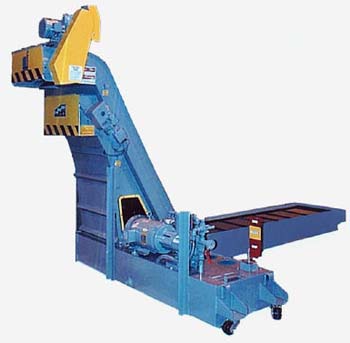
Given the task of improving uptime for the two machines, Keithly and his team of machine operators sought out chip and coolant handling systems that would both reduce the time required for cleaning and better protect the machines' components, tools, and part quality. They found their solution in one unit—the ConSep 2000, from Mayfran International (Cleveland, OH). The system is a combination chip removal conveyor/coolant filtration unit with a small footprint.
The unit requires little more space than traditional chip conveyors, yet cleans and filters coolant at the same time. It handles virtually all types of swarf including ferrous and nonferrous strings, turnings, fines, curls, and nests.
The standard system consists of a hinged and perforated steel belt conveyor for high-volume chips, plus a lower drag conveyor and filter drum for removal of fines. Large chips and strings are simply carried away to the chip discharge chute by the steel conveyor as coolant flows down to the lower area containing the drag conveyor and filter drum. The coolant is maintained at a level below the height of the steel conveyor, helping to drain residual fluid from chips and minimize coolant foaming conditions and the problem of floating chips.
The filter unit separates fines as small as 50 µm, and features a self-cleaning, pressurized backwash for the drum's poly fiber media. The lower conveyor then picks up and carries off the fines. The over/under locating of the two discharge chutes allows collection of chips and fines in the same hopper. The pressurized backwash system for the mesh filter means less downtime for manual cleaning.
The unit stops chip migration to clean side tanks, thus providing longer tool life, improved part tolerances and finishes, and longer fluid life. It also eliminates maintenance downtime, because sumps do not need cleaning.
"Since the installation of the new systems, and except for one time when coolant was mistakenly contaminated with hydraulic oil, we've not had to shut down the Turmatics because of any problems with chips or coolant," Keithly reports. "In fact, over one night shift, one of the machines ran with the pressurized backwash cycle accidentally shut off. In the morning, when coolant levels and flow were noticeably down, we thought we'd have to stop production and manually clean the filter. But first the operator started up the backwash cycle—in no time at all the filter was automatically cleaned and we were back into full production. "
Keithly does relate that, initially, there was a slight problem with the first unit installed, however. "After just a few hours of running, we noticed coolant flow and the amount of chips were creating a backflow, allowing particles to become lodged in the clutch assembly of the hinged, steel belt top conveyor," he says. "This would cause it to kick out and disengage. We notified Mayfran, and they were at our facility the very next business day, reviewing the application. Their solution, replacing the hinged conveyor with one of similar design and material as the lower drag conveyor, resolved the problem immediately."
Mayfran International, a subsidiary of Tomkins, P.O. Box 43038, Cleveland, OH 44143-0038 USA. Phone (440) 461-4100; fax (440) 461-0147.